Guide
How Much Does an ADU Cost in California? (2026)
California ADU costs in 2026 by type and city: detached, attached, garage conversion and JADU, plus permit fees, impact fee rules and common overruns.
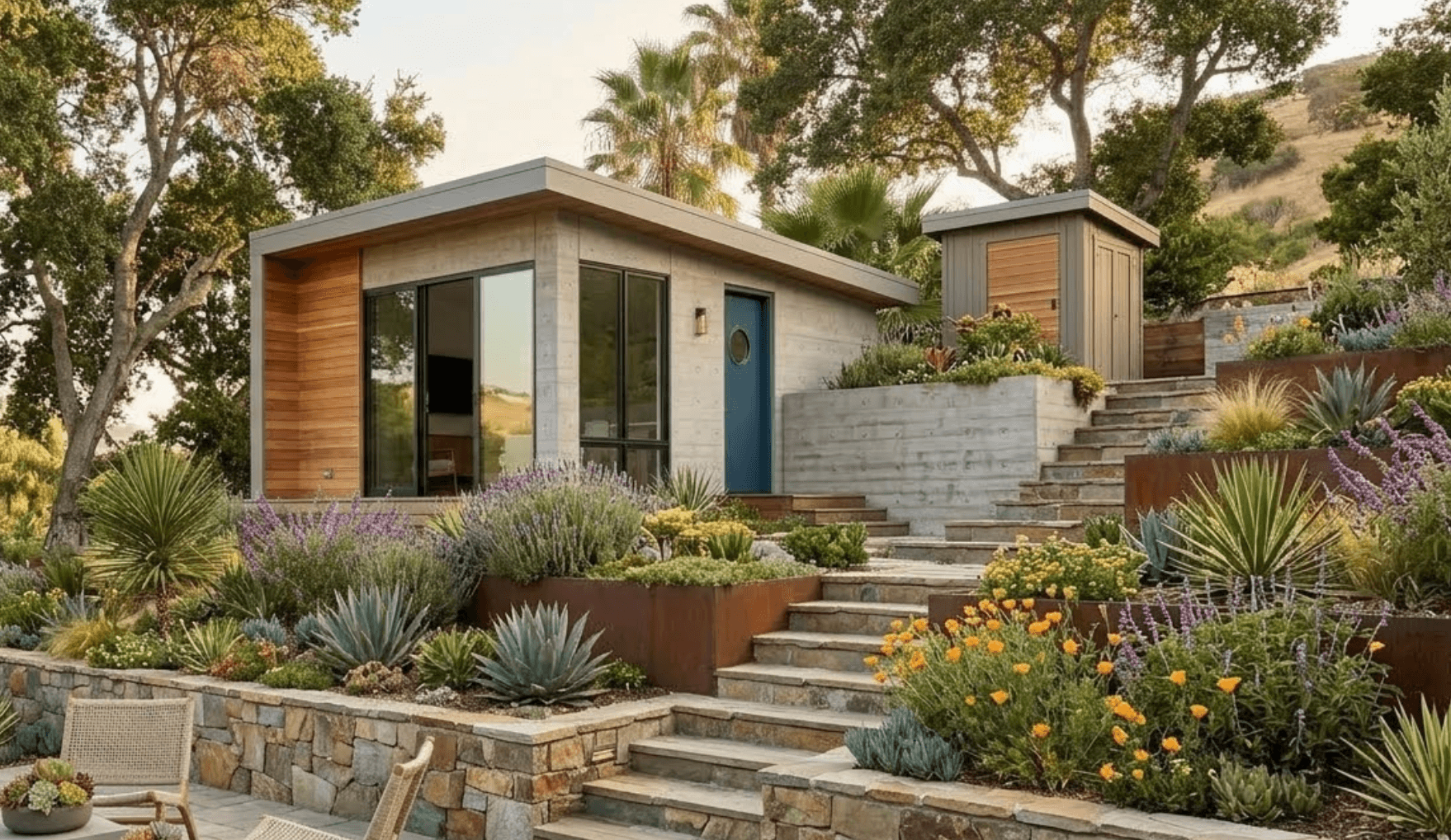
A new detached ADU in California typically costs $150,000 to $400,000 or more all-in, a garage conversion $60,000 to $150,000, and a JADU $30,000 to $80,000. Where you build matters as much as what you build: construction runs about $140 per sq ft at the low end in Bakersfield and up to $700 per sq ft in San Francisco, based on our city data as of 2026.
Key takeaways
- ›Size and location drive most of the price; site conditions cause most overruns.
- ›ADUs under 750 sq ft pay no impact fees, and units of 500 sq ft or less skip school fees too.
- ›Permit fees range from a few thousand dollars to over $30,000 depending on the city.
- ›Budget a 10–15% contingency on top of any contractor bid.
How much does each type of ADU cost?
Typical all-in ranges, including design, permits, construction and basic finishes (not financing), based on contractor quotes and our city data as of 2026:
| ADU type | Typical all-in cost | Notes |
|---|---|---|
| JADU (up to 500 sq ft, inside the home) | $30,000–$80,000 | No new foundation or roof |
| Garage conversion | $60,000–$150,000 | Existing slab, walls and roof |
| Attached ADU | $100,000–$250,000 | Shares a wall and some systems |
| Detached ADU (new build) | $150,000–$400,000+ | Most expensive, most private |
See ADU types explained for size and height rules for each.
How much does an ADU cost per square foot in California?
Detached ADUs are usually quoted per square foot. Our city data (as of 2026) shows wide regional spread:
- ›Bakersfield: $140–$210
- ›Fresno: $150–$220
- ›Riverside: $160–$230
- ›Sacramento: $220–$350
- ›Los Angeles: $250–$400
- ›San Diego: $275–$425
- ›San Jose: $300–$500
- ›San Francisco: $400–$700
Per-square-foot cost usually drops as units get larger, because the fixed costs (foundation work, utility connections, kitchen and bathroom) are spread over more space. That is why a 400 sq ft studio can cost nearly as much as a 600 sq ft one-bedroom. See every city side by side in the ADU cost index.
What drives ADU costs up?
Site conditions. This is where budgets go over:
- ›Slope: grading and a stepped or engineered foundation add cost; hillside lots in Oakland typically run 20–30% more than flatland equivalents, per our city data.
- ›Access: if equipment cannot reach the backyard, materials move by hand.
- ›Utilities: electrical panel upgrades typically run $3,000–$8,000, and a new sewer lateral $5,000–$20,000, based on contractor quotes.
- ›Climate: in the Central Valley, insulation and HVAC sizing are bigger line items than on the coast.
Construction method. Stick-framed builds are the norm. Prefab and modular units shift some work to a factory and can shorten on-site time, but after delivery, crane, foundation and utility work, total cost is often close to site-built.
Finishes. Contractor-grade finishes versus custom cabinets, tile and fixtures can swing a bid by tens of thousands of dollars.
How much are ADU permit and impact fees?
Permit fees are separate from construction and vary widely. Ranges from our city data (as of 2026):
- ›Bakersfield: $3,500–$9,000
- ›Fresno: $4,000–$10,000
- ›San Diego: $4,000–$18,000
- ›Los Angeles: $5,000–$25,000
- ›Berkeley: $12,000–$25,000
- ›San Francisco: $8,000–$35,000
State law caps some fees (Gov. Code §66324):
- ›Under 750 sq ft: no impact fees.
- ›750 sq ft or more: impact fees must be proportional to the size of the main home.
- ›500 sq ft or less: ADUs and JADUs are exempt from school impact fees (SB 543).
Utility connection or capacity fees can still apply. Estimate yours with the permit fee estimator.
How much do ADU plans and design cost?
You need construction drawings to pull a permit:
- ›Simple garage conversion: a few thousand dollars with a draftsperson
- ›Custom detached ADU: often $8,000–$20,000 with an architect, based on typical quotes
- ›Pre-approved plans: under AB 1332 every city must offer a pre-approved detached ADU plan program, and matching plans must be approved or denied within 30 days. Some cities offer plans free: Sacramento has free permit-ready plans under 750 sq ft, Riverside offers free plans from 746 to 1,200 sq ft, and Los Angeles has a city-owned standard plan that is free to use.
Worked example: a 700 sq ft ADU in Fresno vs. San Jose
Same unit, two cities, using our city data (as of 2026):
| Fresno | San Jose | |
|---|---|---|
| Construction (700 sq ft) | $150–$220/sq ft = $105,000–$154,000 | $300–$500/sq ft = $210,000–$350,000 |
| Permit fees | $4,000–$10,000 | $5,000–$20,000 |
| Impact fees | None (under 750 sq ft) | None (under 750 sq ft) |
| Monthly rent range | $900–$1,600 | $2,200–$5,500 |
The San Jose unit costs roughly twice as much but can rent for well over twice as much. At 700 sq ft both skip impact fees but not school fees; shrinking to 500 sq ft would remove those too. Fresno's five pre-approved plans (340 to 1,015 sq ft) include solar plans, which cuts design cost. Run both scenarios in the cost calculator.
What does an ADU cost after it is built?
- ›Property tax: the new construction is added to your assessed value; expect roughly 1% of the added value per year, plus local levies.
- ›Utilities: a separate electric meter adds installation cost; many owners share meters and split bills.
- ›Maintenance: a common rule of thumb is 1–2% of construction cost per year.
- ›Management: property managers typically charge 8–12% of monthly rent.
Is an ADU worth the cost?
It depends on local rents versus build costs. A $200,000 ADU renting for $2,000 per month grosses $24,000 a year, a 12% gross yield before vacancy, taxes, insurance and maintenance. In a lower-rent market, the same budget pays back much more slowly. Model your city in the ROI calculator, compare loan payments in the financing calculator, and read ADU rental income.
The CalHFA $40,000 ADU grant has been closed since December 2023 with no new round announced, so do not count it in your budget. See ADU financing 101 for current options.
How do you get an accurate ADU quote?
Get at least three bids with the same scope and finish level. Ask each contractor to break the bid into site work, foundation, framing, roofing, mechanical, electrical and plumbing, interior finishes, and exterior work. Line items show where bids diverge. Then add 10–15% for contingency. Our guide on hiring an ADU contractor covers what to check before you sign.
Sources
Free Service
Ready to Start Your ADU Project?
Get free quotes from licensed ADU contractors in your city. No obligation, takes 2 minutes.
Get Free Contractor Quotes